
Ayşe Arman Interview
The world’s finest piano duo, Güher–Süher Pekinel, were recently honored with Germany’s highest Order of Merit.
In a single word: they are extraordinary!
The Pekinel Sisters are among the greatest piano virtuosos in the world—perhaps even the greatest.
What they have achieved is something only a very few people can attain… Because it requires an almost insane level of effort, relentless work, extreme discipline, and total dedication… Otherwise, it would be impossible. You couldn’t study at the world’s best schools, become one of the best in the world, or remain relevant for so many years through your art…
We should all bow before them with respect… This is something far beyond “success.” In my opinion, it is DEDICATION.
We should be bursting with pride that they come from our country. We should be showering them with awards. But apparently, we don’t quite understand such things. We glorify pop singers whose voices and talent don’t even cross Kapıkule, yet we keep our distance from our classical musicians who inspire admiration all over the world. That is our shame. Unfortunately, it also reveals our level.
Think about the effort it takes for a person to become “the best” in the world… The disciplined work, the passing years, the patience, the concentration… That’s why I call it DEDICATION. I bow before them with respect and applaud until my hands ache.
Recently, they were honored with a special decoration—an award given by Germany to artists who foster global dialogue in the field of culture and the arts. One wishes that such awards were given by our own institutions, but they are always busy with other matters—these days, for example, they are obsessed with the Moon.
Meanwhile, the Pekinel Sisters have been running three separate educational projects for many years. One of them is the “Young Musicians on World Stages”
(DSGM) project, aimed at compensating for the lost generations in classical music in Turkey.
They ensure that exceptionally talented applicants continue their education with distinguished musicians and pedagogues, and they provide opportunities and instruments so these young people can participate in major international competitions.
Thanks to the Pekinel Sisters, Turkey has won 17 first prizes in prestigious international competitions.
With the Güher–Süher Pekinel Anatolian Orff Education Project, they have enabled 450,000 children across Anatolia to receive music education starting from kindergarten
Students trained in the Pekinel Music Department they established in 2007 at the Turkish Education Foundation İnanç Türkeş Private High School—an institution for gifted youth—graduate from prestigious universities such as Harvard, Columbia, Princeton, and Stanford.
They truly accomplish extraordinary things. And they are incredibly humble. I thank them for this interview.
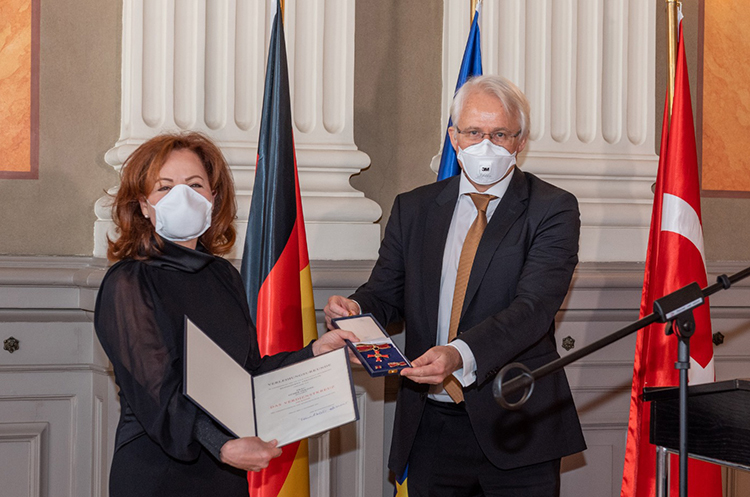
It is an indescribable happiness and honor for us… It is the reward of our efforts! The recognition of our dedication on an international level… And of course, it makes us feel understood. Naturally, we are very happy and proud. Just as justice eventually finds its place, the recognition and appreciation of our international work strengthening intercultural dialogue—and the music education systems we have developed in Turkey since our university years—give us hope.
OUR PASSION FOR MUSIC IS AN ENDLESS JOURNEY
However, just as great challenges do not discourage us in our musical journey, awards do not stop us either. We have not reached—and cannot reach—a point where we say, “That’s it, we’re done.” The pursuit of “absolute perfection” is an endless journey that constantly renews our inner energy.
THESE AWARDS ARE PART OF OUR BREATH
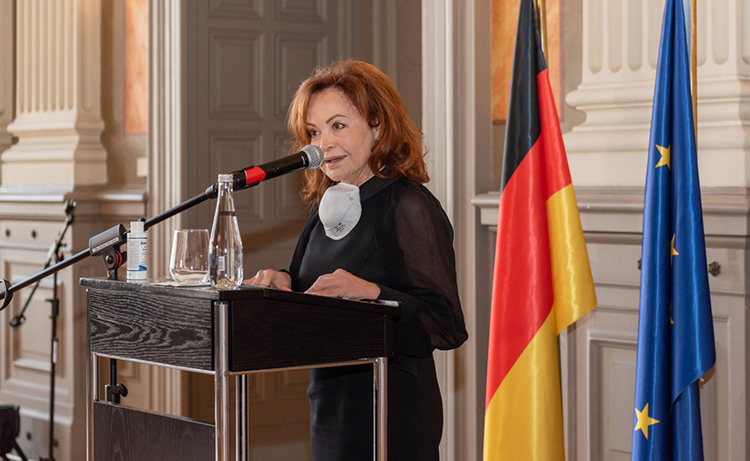
This particular award, the “Bundesverdienstkreuz,” is given by Germany to exceptional individuals for their contributions to global music and intercultural dialogue. Among all the awards you’ve received in your lifetime, what place does it hold?
The first prizes we have received throughout our career have always propelled us forward. Lifetime achievement awards and medals confirm that we are on the right path. They are so valuable that they become a part of our very breath.
WE ALWAYS DEFINED OURSELVES AS CITIZENS OF THE WORLD WITH OUR TURKISH SPIRIT
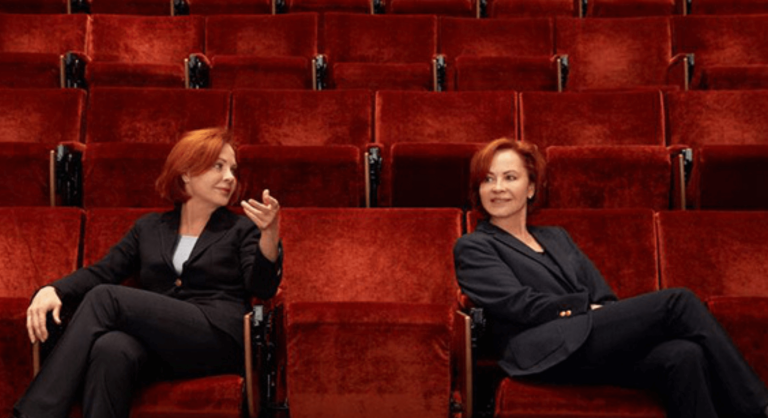
Where do you feel you belong most? Whenever I hear your German, I’m amazed—it’s so good… But I can’t simply call you Turkish or German… It’s as if you are everything and belong everywhere… Do you feel like citizens of the world?
What a beautiful way to express it! Yes, together with our Turkish spirit, we have always felt like citizens of the world. Because our musical language is a universal one. Music is a language that unites people beyond all boundaries. As musicians who speak this language, we see ourselves as travelers who belong everywhere, beyond time and space.
WE HOPE WOMEN’S VOICES WILL GROW STRONGER IN POLITICS AND THE ARTS
Kamala Harris, the new Vice President of the United States, who is of Asian descent, has signaled—through her commitments—the emergence of a new political arena shaped by women’s perspectives. Biden’s cabinet also includes some very interesting profiles.
Fields that were previously dominated by men—such as the economy, finance/central banking, and intelligence—are now led entirely by women politicians. The communications team is composed entirely of women as well. Additionally, three female politicians of Turkish origin are also part of the cabinet.
Not only in the United States, but in Europe as well, women politicians are influential. For example, as is known, the President of the European Commission is a woman. The President of the European Central Bank is also a woman. Women are in charge of monetary policy and politics in the EU. Following Merkel, women prime ministers—especially in Europe, notably in Iceland, Denmark, and Norway—have also left their mark on the Covid-19 period with their effective policies.
We hope that women’s voices will grow stronger in politics and the arts, as they deserve, and that in the long term, this will transform the entire world order.
THE ESSENTIALS: PROPER EDUCATION, DEDICATION, DEPTH, AND DISCIPLINE
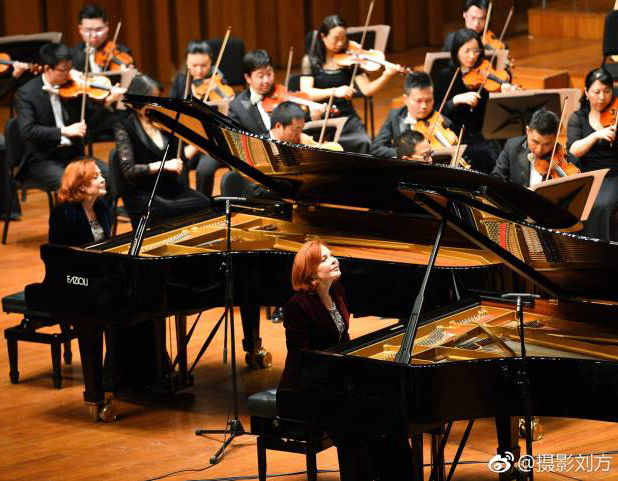
What is indispensable in your art?
Intensive, disciplined work is crucial. Proper education, dedication, a focus on depth, and discipline… Only through the combination of these can you develop your own unique interpretation. This applies not only to our profession but to all fields.
OUR MOTHER WAS A PIANIST IN LOVE WITH MUSIC
your mother was a pianist and your father was interested in painting. Was it your mother who mapped out this future for you?
Our mother was a lover of music and art. Music was naturally a part of us, because for as long as we can remember, it filled every corner of our home. With her magical touch, our mother motivated us along this path. We felt the impact of her enchanting touch throughout our lives.
When did your interest playing the piano began?
At the ages of 3–4. She brought us to the conservatory at the age of 4.
A LIFE WITHOUT DEDICATION TO MUSIC WAS NEVER AN OPTION
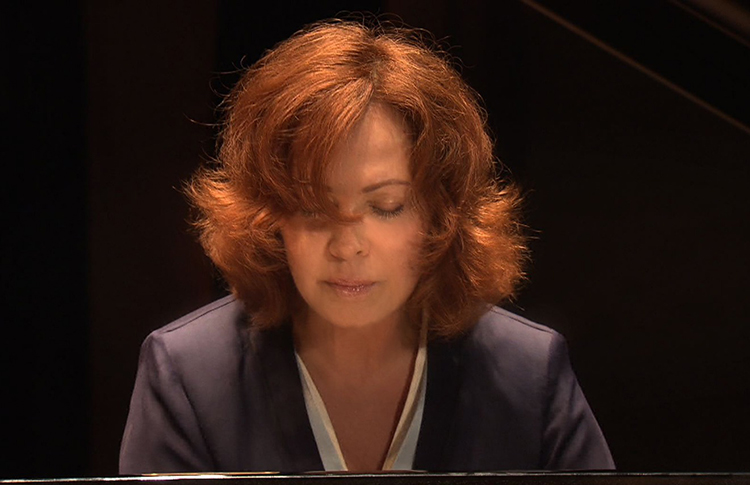
What if one of you had said, “I don’t want to dedicate my life to music”?
A life not devoted to music was never even possible for us. Our dream was to reach the depth of music and express it in its purest form. Thinking otherwise is impossible for us.
BEING TWINS AND PLAYING TOGETHER IS NOT A CONFINEMENT, BUT FREEDOM
Isn’t it also frustrating to be dependent on each other?
Nooo! Why would it be? Otherwise, no duo, trio, quartet, or orchestra would be able to produce together for years and still be making music today.
But still—you can’t just throw each other away, … You’re bound to one another for life… Isn’t that both a reward and a punishment?
It isn’t. If you see it as a “punishment,” wouldn’t that mean questioning siblinghood, friendship, togetherness, even marriage? For us, it’s not confinement but freedom. Not a punishment, but a reward. Because our differing perspectives grow by nourishing one another, and in doing so, they carry us forward. They enrich our identity with new dimensions.
A UNIQUE UNITY THAT GOES BEYOND SISTERHOOD… EVEN THEIR HEARTBEATS ARE IN SYNC
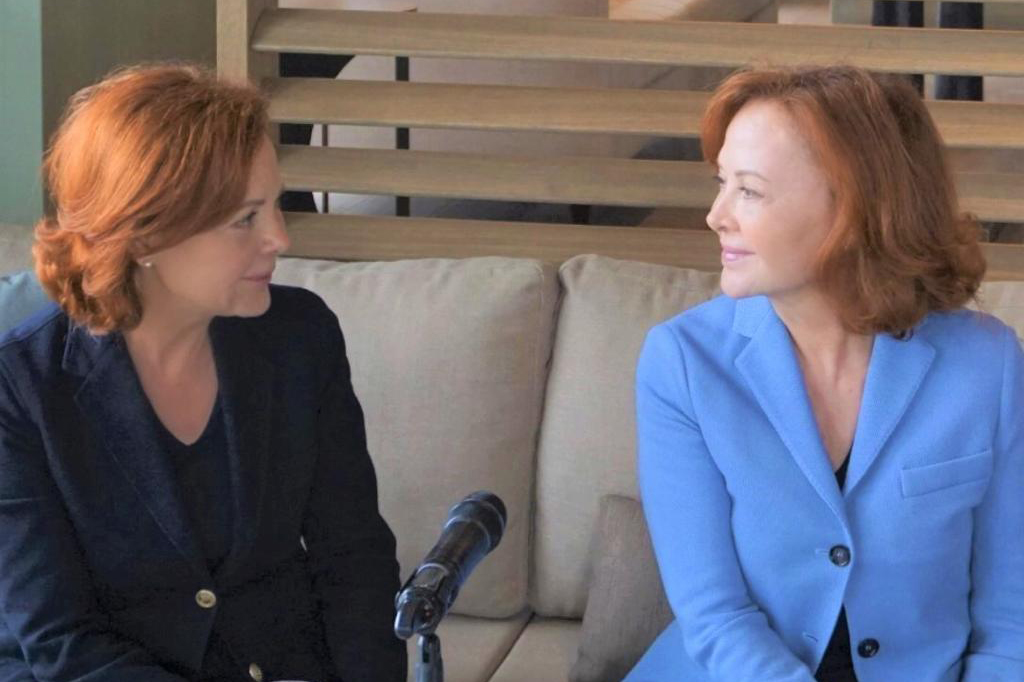
Do you feel like two halves of a whole?
Life is a journey in search of infinite harmony within the cycle of the senses. In this journey, through the phenomenon of twinhood, we feel that we complete each other most in the moments when we face the greatest difficulties. This feeling is a unique form of togetherness that goes beyond sisterhood. Peter Cossé once wrote about this bond, saying, “…the Pekinels, born in absolute proximity to one another, whose very pulses beat in harmony, capture this same harmony in the style of their music…” We could not have expressed it so beautifully ourselves.
WE ARE THE ONLY TWIN PIANO DUO WITH A GLOBAL CAREER
You’ve been subjected to these twin-related questions all your life, right? Isn’t it boring?
No, not at all. Twinhood is an interesting phenomenon. We understand people’s curiosity. Moreover, we are the only twin piano duo with an international career. For that reason, we answer such questions with enjoyment, sometimes with a touch of humor.
PASSION IS THE ELIXIR OF LIFE
What role does “passion” play, and to what extent, in the success you have achieved? Would “disciplined work” and “the determination to continue” alone have been enough to reach the level of today’s Güher–Süher?
Just as talent alone is not sufficient, beyond discipline and determination, “passion” is the elixir of life. We completed our education by pursuing the dreams we fit into a single suitcase, moving from country to country, thanks to our passion for music.
We are sure you observe a similar passion in Alya as well.
EVERYTHING STARTED BY IMITATING OUR MOTHER AT THE PIANO
Let’s come to where the story began… Your mother is a pianist, your father is interested in painting. A home overflowing with art. What is the story behind your becoming pianists rather than painters?
Every child has certain moments that affect them—moments that develop naturally. Trying to imitate our mother at the piano was one of those defining moments for us. So much so that she would sometimes hear from the kitchen that the piano in the back room was being played incorrectly and would warn us. There is no doubt that she was the one who discovered the musical talent within us.
CHILDHOOD, YOU SAY? WE PLAYED PIANO IN HEYBELİADA IN THE SUMMERS, AND THE REST OF THE TIME WE WERE MISCHIEVOUS, CLIMBING TREES AND NEVER COMING DOWN!
What kind of childhood did you have? Were you able to live it to the fullest?
We had a very joyful childhood centered around the conservatory, home, and summers in Heybeliada. In fact, we also wanted to receive ballet training. After entering the conservatory at the age of five, we found the solfège classes boring and would sneak off to ballet instead. Our mother would find us dancing ballet among the students. We must have looked very funny—we laughed at ourselves too. Despite our passion for ballet, the sounds and keys of the piano began to draw us in. In the summers, we would play piano in Heybeliada; at other times, we would be mischievous, climbing trees and never coming down…
WE ENTERED THE CONSERVATORY AT AGE 4
You gave your first concert at the age of 6. For heaven’s sake, at what age did you start playing the piano then?
Well, when we were 4 years old, at the request of our teachers, our mother took us to the conservatory entrance exams. We passed the exam, but since the minimum age for admission was 5 at the time, we first began with private lessons with the director of the conservatory of that time, Ferdi Statzer. Upon his recommendation. Our school concerts also started from the age of 6. The most important concert for us in those years was the one we gave at age 9 with the Ankara Presidential Symphony Orchestra at the Radio House. Not fully grasping what a live broadcast meant, we went on stage as comfortably as always. What we remember is that our stool was very low, so they had stacked three chairs on top of each other—and we couldn’t reach the pedals anyway.
BEING TWINS IS BOTH CHALLENGING AND COMFORTING
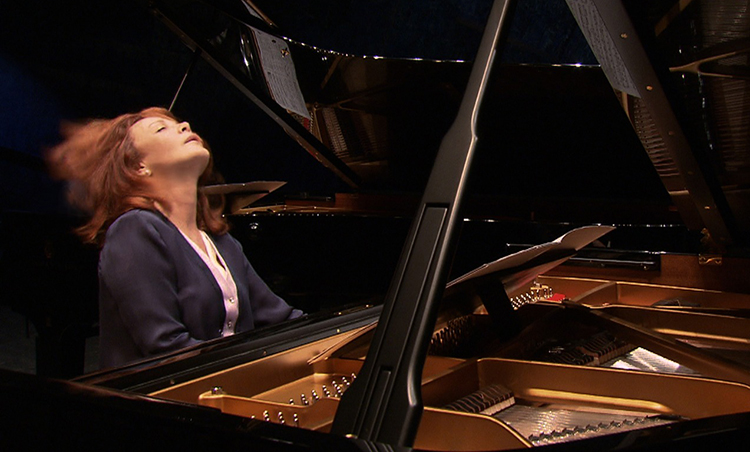
Is being an identical twin something that makes life easier or more difficult in childhood?
Having someone who resembles you in every way is a feeling that both challenges you and makes you feel secure. At times, you can switch roles and help your sibling in difficult moments. The downside is being mistaken for one another. But with lived experiences and what life has added over time, we now experience just how privileged it is to be a twin.
THE PIANO WAS A GREAT DISCOVERY AND PLAYTHING FOR US
Have there ever been times you felt you couldn’t play because of the piano?
No, never. On the contrary, the piano was a great discovery and plaything for us. If it hadn’t been like that—if we hadn’t enjoyed it—we could never have developed a long-lasting passion for it.
“YOUR DAUGHTERS HAVE A VERY SPECIAL TALENT!”
What do you think today about your first teacher, Ferdi Statzer?
Ferdi Statzer, the director of the conservatory at the time, was a student of Alfred Cortot and reflected the world-famous French piano school. He told our mother, “Your daughters have a very special talent; I will give them lessons twice a week,” and started coming to our home for private lessons. Because of his German-Austrian background, he was very disciplined. Thanks to him, we got used to discipline at an early age. At least this prepared us well for the discipline-focused Notre Dame de Sion.
You’re receiving the world’s best music education. How does that feel? Always being with the best, the most talented, always studying at the top schools…
A huge privilege! We embarked on this educational path thanks to our very valuable teachers. We cannot thank them enough. Winning first prizes, being recognized by iconic artists, working with them—these are among the most important building blocks of our careers. Of course, it contributed immensely to us.
Was there ever a time you wished you were “ordinary”?
With what we achieved instinctively, going back to being ordinary is impossible. Every extraordinary artist breaks ordinaryness with the innovative dimensions of creativity. That’s what we did too.
ONE STUDIED PSYCHOLOGY, THE OTHER PHILOSOPHY
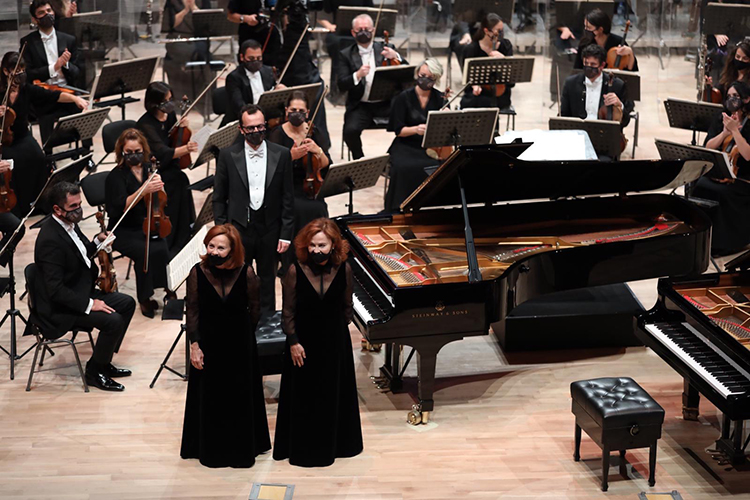
At age 18… one of you studied philosophy, the other psychology. Was there a special reason for this?
Our family always made us feel the importance they placed on academic education. But naturally, we made this decision ourselves. For us, evaluating music philosophically and psychologically, understanding its foundations and giving them meaning, was very important. These studies also formed the basis for the ideas we systematized in music pedagogy and education.
Did you think that only studying music would leave you incomplete?
Unfortunately, although music has been a multi-disciplinary and multi-faceted science for years, it has often been underestimated. Daniel Barenboim points out in his book Everything is Connected: The Power of Music that despite music being such an integral part of our lives, it has been addressed as a science using different academic approaches very late.
What did philosophy and psychology add to your personality and music?
Our university years were very intense. During our student years, three major thinkers—Mitscherlich, Habermas, and Adorno—deeply influenced us. We entered a period of self-questioning. Around us, people constantly said, “You can’t change anything with music!” At Goethe University, working groups were established to discuss social problems and find solutions. We participated in these groups. Philosophy and psychology classes during these lively years allowed us to evaluate music from completely different perspectives, shaping our thinking in new dimensions. We realized that music is the real power within us. Observing and experiencing all this deeply affected our music and identity in every way. We are glad we experienced it!
WE STARTED PLAYING TOGETHER AFTER AGE 24… FATE, LUCK, DESTINY—WHATEVER YOU CALL IT, BROUGHT US HERE
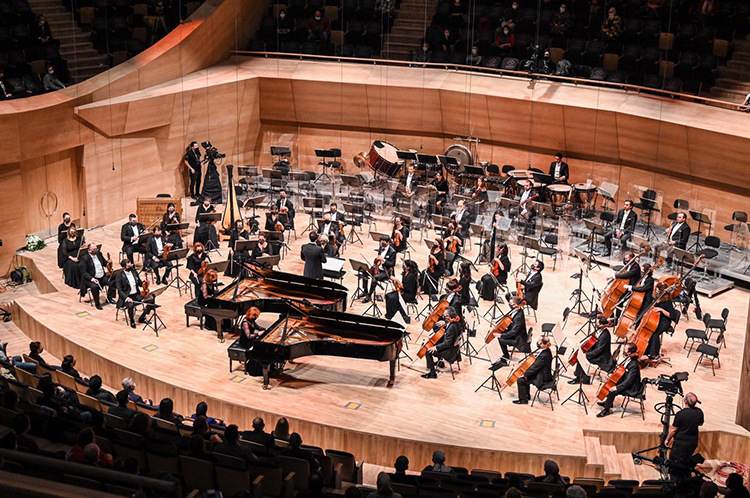
You didn’t play together until age 24… Why? And what made you decide to play together after that?
We wanted to select and interpret every piece individually, living our love for music alone. While doing our master’s at the Juilliard School of Music, our teacher encouraged us to enter the “Young Concert Artists New York” competition as a duo, which we won. Then, after receiving an offer from ICM, we started our duo career. After a series of conscious choices, fate, luck, destiny—whatever you call it—brought us to this point.
WE LIVE WITH LOVE IN EVERY CELL OF OUR BEING
Intense work with many awards and a strict line of achievement… What about private life? Life’s pleasures… love?
Love is a journey into the depth that everyone experiences in their own way. Because of our profession, being public figures, and the fact that creativity is part of our process, we try to protect the boundaries of our private lives. We live with love in every cell of our being.
SINCE OUR FIRST HEARTBEAT, WE’VE BEEN CONNECTED BY OUR INTERNAL RHYTHM
You can play the same thing with incredible sensitivity without seeing each other. What kind of telepathic connection is this?
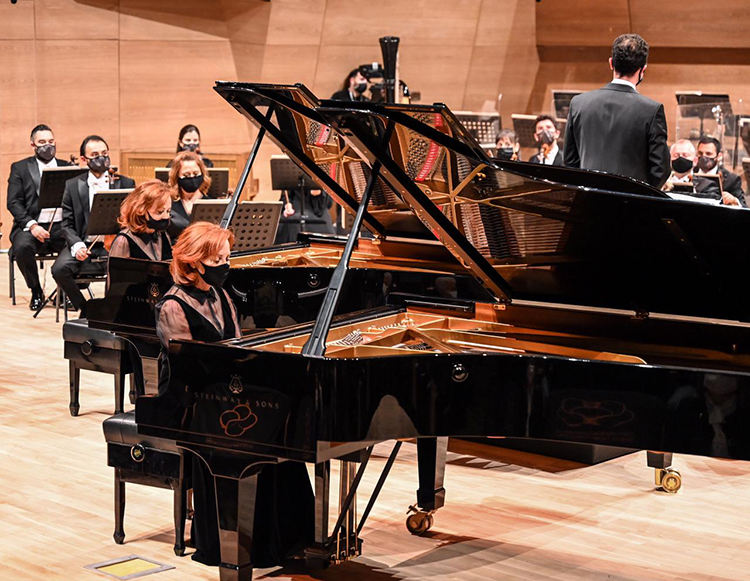
Being born simultaneously, sharing the womb, and being the first people we see upon entering the world… Perhaps all of this strengthens our telepathic bond. From our first heartbeat, we are connected by our internal rhythm. When one of us’s heartbeat accelerates, the other may slow down, or we accompany each other. This is how we maintain balance. We also use this telepathic bond as a tool to create surprises. To maximize the impact of this surprise, we decided to place our pianos one after the other.
THE DAY WE FIND OURSELVES, WE WILL STOP PLAYING MUSIC
Isn’t it tiring to play every time discovering a new detail?
Before his death, Max Ernst said about his own artistic identity: “The day I find myself, I will stop painting!” We feel the same about music. Discovering a new detail every time is, on the contrary, a reward. It is the reward of the intense and in-depth work we do. Moreover, sharing this moment with the audience is an entirely different joy. Every new layer we discover, a different orchestra, the variable acoustics of a new hall, our mood that day, the audience’s mood, the unique tones of two new pianos—all these factors combine to make the “momentum” special and also provide new motivation.
THE CONCERT MOMENT IS A UNIQUE AND TRANSCENDENTAL MOMENT FOR BOTH US AND THE AUDIENCE

Why do you give so much importance to creativity in music? Isn’t playing correctly, sensitively, and beautifully enough to move people?
For us, the concert moment is a unique and transcendental moment for both musicians and the audience. Playing correctly, accurately, and sensitively can produce a good concert or recording. But only when creativity comes into play can you elevate the performance moment—which we call “momentum”—to the next level. Our “Treasures Box” album, which captures concert moments in all their purity, has received excellent critical reviews and features a selection of works composed for two pianos. It includes 4 DVDs, 2 Blu-Rays, 7 CDs, and a book, and has already reached listeners. We believe new releases that will excite listeners even more will follow this album.
THE WORLD’S BEST DUO
How does the title “the world’s best duo” affect you? Does it please you, or does it pressure you?
It motivates us in our work. Especially in piano duos, the process is longer. As a duo, you must also memorize your partner’s part. In this intense process, redefining details again and again while maintaining balance and advancing musical expression positively affects us.
WITH 47 YEARS OF INTERNATIONAL EXPERIENCE, WE STARTED THIS SUPPORT TO SHARE OUR KNOWLEDGE WITH YOUNG MUSICIANS: YOUNG MUSICIANS ON WORLD STAGES!
Today, you are doing incredible work! You provide strong support to young people in music education. Young talents from your music department are accepted into Harvard, Berkeley, and Princeton. How does this make you feel?
Life is an educational journey. By sharing, we deepen our understanding of existence, question ourselves, and discover and develop different creative sides. Throughout our career, each time we came to Turkey to perform, we tried to find solutions for what could be done in music education and how to transfer the opportunities we had received. Over time, our ideas evolved into structured reality. Ultimately, we believed it was necessary to start a music education system that would transmit the opportunities we were given, as well as our 47 years of international experience, to young musicians. The main focus: alongside general music education, ensuring extraordinary young talents perform on world stages at a very early age. While enabling exceptional musicians to access world-class opportunities within “Young Musicians on World Stages,” we provide living stipends, instrument grants, and other important expenses, sometimes with our own financial contribution. Following a volunteer principle, and for transparency and fairness, we prioritize direct payments to scholarship recipients—unlike common practice.
YOUNG PEOPLE! LISTEN TO THE WORKS PRESENTED, QUESTION THEM, AND INTERNALIZE THEM!
What is the most important message you want to give to music-loving children?
Music is a universal medium that appeals to all senses, the soul, and the mind, balancing inner rhythm, transcending boundaries, and enabling us to experience creativity at its maximum. From this perspective, we believe that young people listening to works, questioning them, and internalizing them will encounter new discoveries in music. This applies to all art forms. Once they hold the key to this magical language, they should never let go. As they develop themselves, this key will open new doors.
WE LIVE OUR LIVES SHUTTLING BETWEEN THREE CITIES… ZURICH–LONDON–ISTANBUL
What is your routine? In how many countries do you live at the same time?
Our daily life is quite intense. According to our recording and concert schedule, we have daily piano practice. In the music education systems we run, we maintain direct contact with exceptional young musicians, teachers, and students. Due to Covid-19, we dedicate time to online exhibitions, concerts, ballet, and performance arts. We also follow social media within the balance of our interests, professional careers, global citizenship, and education systems, and try to reflect it on our own Instagram account. We live our lives shuttling between three cities. Whenever possible during Covid-19, we experience culture, art, and music actively in London and Istanbul, while in Zurich we reconnect with nature and find peace in calmness.
WE OWE OUR FITNESS TO CONSTANT ACTIVITY AND THE EFFORT TO KEEP UP WITH EVERYTHING
You always look beautiful, you never seem to age, and you are always fit. How do you do this?
Thank you very much. We don’t make a special effort; perhaps it’s the energy inside us reflecting on our face and body. Our fitness comes from constant activity and striving to keep up with everything. In any work done with love and belief, the energy from within reflects on your appearance.
WHEN WE HAD THE OPPORTUNITY TO MEET HERBERT VON KARAJAN, WE OBSERVED THAT HE ALSO PLACED GREAT IMPORTANCE ON STAGE PRESENCE, AESTHETICS, AND CORRECT BODY LANGUAGE
>Some male pianists develop a strange, amorphous body from poor posture or inactivity and gain weight… How do you prevent this?
Stage presence, aesthetics, and correct body language are part of the overall artistic expression. While studying at Juilliard School of Music in New York, we attended drama, ballet, and theater classes to learn about proper breathing and stage posture. When we met Herbert von Karajan, we observed that he also valued these details greatly.
WE EXPERIENCED COVID TOGETHER
Did you experience Covid together? Did you both get the virus in the same place?
We caught the virus during our journey from Zurich to Istanbul. Since we contracted it at the same time, we experienced it together. It was mild; we didn’t have severe symptoms. The entire Covid-19 period also highlighted environmental, consumption, and climate issues that humanity had postponed despite repeated warnings from scientists. Especially during this period, we observed that Gen Z’s interest and activism increased. Conscious consumption, aligned with nature, is becoming a key trend. Like everyone, we are deeply connected to nature. Omraam Mikhael Aivanhov says, “In nature, everything is music. In flowing rivers, gushing springs, falling rain, roaring floods, the sound of wind, rustling leaves, and birds’ chirping, there is music.” The miraculous balance of nature also helps maximize the human potential and inner power. Music, for us, reflects this balance.